


191. Transform your vision – ask us how!
It starts with a simple spreadsheet. You track a few orders, manage a small inventory list, and it feels like magic. It’s free, it’s flexible, and everyone knows how to use it.
But for a growing packaging business, there comes a day when that “flexible” tool starts to feel like a cage. You aren’t just managing data anymore; you’re fighting it.
If you’re wondering if your operational friction is just “growing pains” or a fundamental tool failure, here are signs:
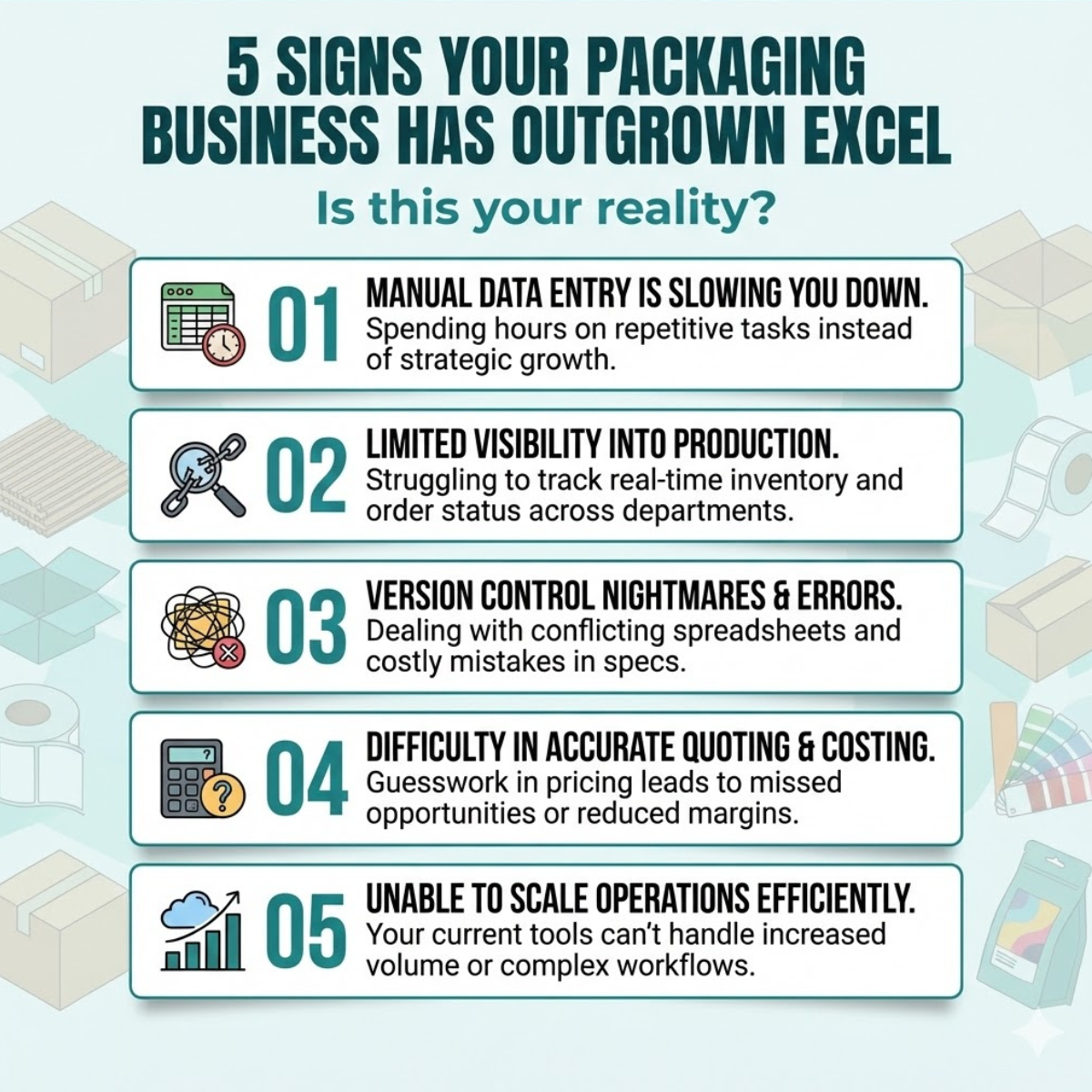
1️⃣ Manual Data Entry is Your Main “Job”
In the early days, entering data manually was a rite of passage. In a scaling business, it’s a bottleneck. If you or your key team members are spending hours re-keying specs, updating quantities, or copy-pasting customer info from emails into cells, you aren’t focused on strategic growth.
Every minute spent on manual entry is a minute not spent on product innovation or closing new accounts.
2️⃣ You’re Flying Blind on Production
Can you tell, at this exact moment, where a specific job is on the floor? Or exactly how much substrate you have left in the warehouse without walking back there?
Excel is static. Production is fluid. When you lack real-time visibility, you end up with:
- Over-promising to clients because you didn’t see a production delay.
- Over-ordering (or under-ordering) inventory.
- Internal silos where sales have no idea what production is doing.
3️⃣ The “Version Control” Nightmare
When multiple departments (Sales, Design, Production) are working off different versions of a spreadsheet, costly mistakes are inevitable. A slight error in a dieline or a color spec—caused simply by opening an outdated file—can result in an entire pallet of unsellable products.
4️⃣ Quoting Feels Like Guesswork
In the packaging world, margins are won and lost in the pennies. If your quoting process relies on “the way we’ve always done it” or complex formulas that only one person in the office understands, you’re at risk.
- Too high: You lose the contract.
- Too low: You win the contract but lose money on every unit.
- The Result: Without an integrated costing system, you’re guessing, not calculating.
5️⃣ You’ve Hit the “Scaling Ceiling”
You want to double your volume this year. Can your current spreadsheet system handle 2x the orders? 5x the complex workflows?
Excel doesn’t scale; it just gets more “fragile.” The more rows you add and the more macros you build, the more likely the whole system is to crash. True scalability requires automation and integration, things a spreadsheet was never designed to provide.
Recognizing these signs isn’t a failure—it’s a milestone. It means your business is moving to the next level. The tools that got you here are rarely the same tools that will get you there.
When you move beyond the grid, you stop managing spreadsheets and start managing a powerhouse packaging operation.